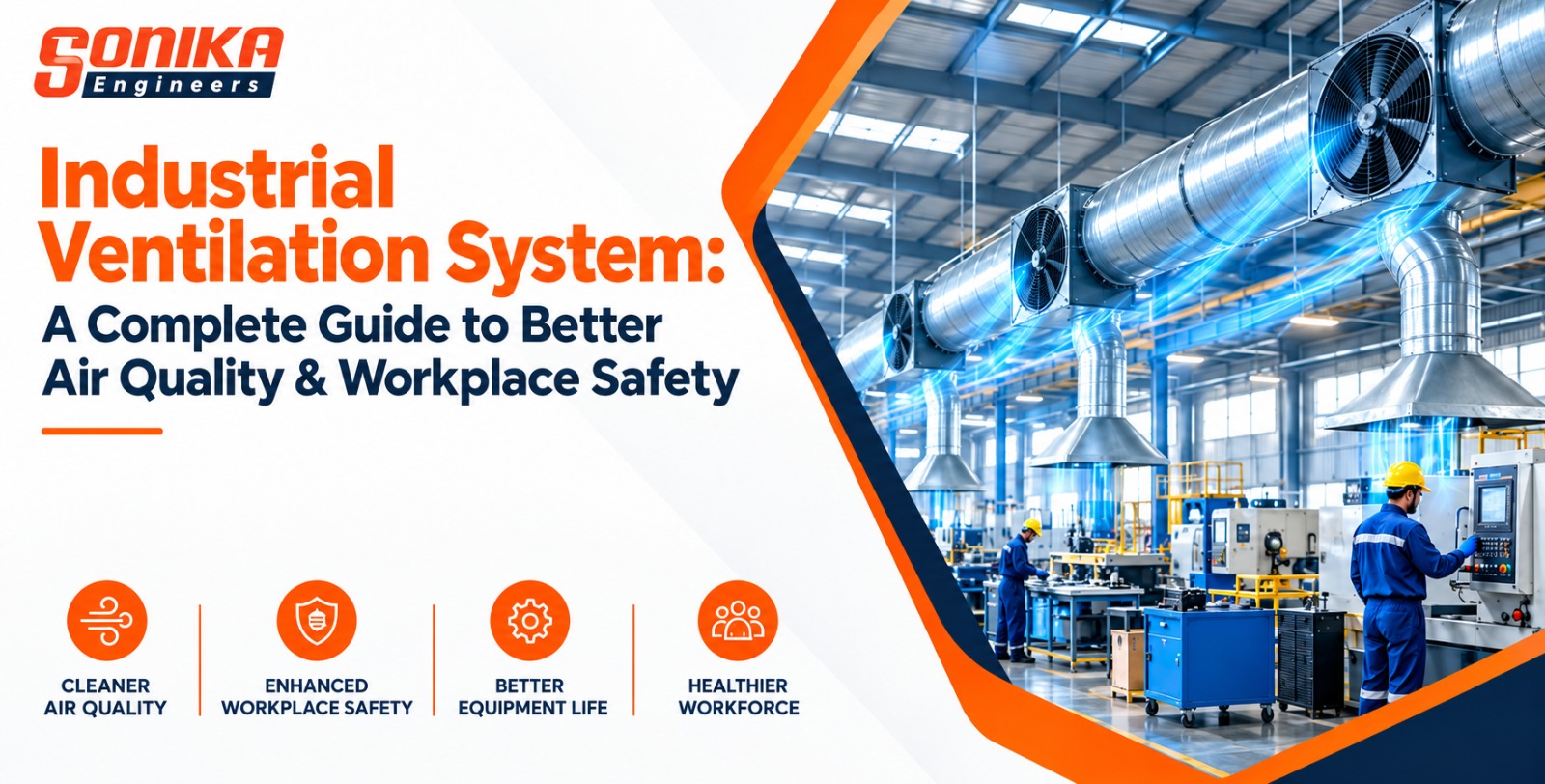
Walk into a busy factory and you can often feel the difference immediately. Machinery may be running continuously, temperatures can rise quickly, and some production processes may create dust, fumes, smoke, or moisture. When this air is not properly managed, the working environment can become uncomfortable and difficult to maintain.
A properly planned industrial ventilation system helps solve these challenges by moving stale air out, bringing fresh air in, controlling excessive heat, and supporting a healthier workplace. Industrial roof exhaust fans can help remove hot and stale air from industrial spaces. For businesses looking for dependable industrial ventilation and exhaust solutions, Sonika Engineers offers industrial fans and blowers for a range of industrial applications.
What Is an Industrial Ventilation System?
An industrial ventilation system is an arrangement of components that regulates and controls airflow in factories, warehouses, workshops, and other industrial structures. Based on its application, it can help remove excessive heat, gases, smoke, dust, moisture, and stale air.
The components used in a proper system may include exhaust fans, blowers, fresh-air inlets, louvers, ducts, filters, and others. The selection depends on factors such as building size, manufacturing process, number of workers, and type of contamination.
For instance, a welding workshop may require dedicated extraction equipment, while a large manufacturing building may mainly need continuous removal of hot air.
Why Factory Ventilation Matters
Poor airflow can cause heat, humidity, fumes, and other unwanted airborne conditions to remain inside a building. Apart from affecting employee comfort, these conditions can make the production environment harder to manage.
A properly designed factory ventilation system can help maintain a more comfortable environment by creating a controlled path for stale air to leave and fresh air to enter.
Some key benefits include:
-
Removing excess heat from production areas
-
Improving movement of fresh air
-
Reducing stagnant air
-
Supporting employee comfort
-
Controlling humidity and moisture
-
Helping maintain cleaner production areas
-
Supporting better workplace air quality
Good ventilation is not simply about installing a powerful fan. Airflow direction, fan capacity, exhaust-point location, fresh-air entry, and operating conditions all need to work together.
How Roof Ventilation Removes Hot Air
In most industrial structures, heat from machinery, furnaces, manufacturing equipment, and other processes tends to move upwards towards the roof. Therefore, the upper portion of the building can be an effective location for removing hot air.
A properly designed roof ventilation system can help remove hot and stale air while supporting continuous airflow through the facility.
Properly installed industrial roof exhaust fans can be beneficial for large enclosed structures where considerable heat is generated.
However, exhaust capacity also needs to work together with fresh-air replacement for effective ventilation.
Choosing the Right Industrial Exhaust Equipment
Every factory has different requirements. Before selecting an industrial exhaust fan, it is important to understand what needs to be removed and where the problem is generated.
Is excessive heat the main issue? Are fumes produced at a specific workstation? Is dust spreading across the production floor? Is moisture difficult to control?
The answers can influence the type, size, capacity, and positioning of ventilation equipment.
Building volume, required airflow, pressure, operating temperature, available power, environmental conditions, and working hours should also be considered.
Simply selecting the biggest fan is not always the right approach. An efficient system is one where the equipment matches the actual application and airflow requirement.
Industrial Air Circulation: Its Importance
Proper industrial air circulation can play an important role in large enclosed workplaces. Where there is little air movement, areas with poor airflow and overheating can develop around machines and manufacturing zones.
Continuous and well-directed airflow can help avoid such areas and make the workplace more comfortable, especially when machines produce considerable heat.
However, general airflow and contaminant extraction are not always the same. If specific operations produce concentrated dust or fumes, the source may need dedicated extraction rather than only general ventilation.
Heat Extraction in Factories
Heat can become a serious problem in manufacturing facilities, especially during summer or where furnaces, boilers, compressors, motors, or other heat-generating equipment are used.
Effective heat removal in factories starts with identifying the sources of heat and how it moves through the building. Since hot air tends to rise, high-level exhaust can help remove accumulated heat from the upper part of the facility.
The actual improvement depends on building design, outdoor conditions, internal heat sources, airflow, and ventilation capacity.
When Fume Extraction Is Required
Some industrial processes produce fumes, smoke, vapours, or other airborne contaminants. Welding, painting, chemical handling, heating, and certain manufacturing operations are examples where ordinary air movement may not be sufficient.
A dedicated fume extraction system is designed to capture contaminants closer to their source before they spread through the wider workplace.
This type of ventilation requires careful planning because capture location, airflow, duct arrangement, filtration, and discharge points can influence performance.
For facilities dealing with specific or potentially hazardous contaminants, ventilation should be designed according to the process and applicable workplace requirements.
Importance of Selecting the Right Equipment
Ventilation equipment is part of a wider system. Fan capacity, pressure, motor selection, construction materials, installation location, controls, and maintenance requirements can affect overall performance.
Before selecting equipment, a company should assess its application. An experienced manufacturer can assist in determining suitable equipment according to airflow and operating requirements.
Sonika Engineers provides industrial fans and blowers for different industrial applications and ventilation requirements.
Maintenance Keeps Ventilation Working Efficiently
Even a well-designed ventilation setup can lose performance when maintenance is ignored.
Fans should be inspected regularly for unusual vibration, excessive noise, loose components, electrical problems, dirt accumulation, and changes in airflow. Depending on the installation, ducts, filters, and louvers may also require inspection and cleaning.
A planned maintenance routine helps identify smaller problems before they affect the entire ventilation system. Rooftop equipment, including industrial roof exhaust fans, deserves particular attention because performance issues may not always be visible from the factory floor.
Frequently Asked Questions
1. What is the main purpose of industrial ventilation?
The main purpose is to control airflow and help remove unwanted heat, fumes, dust, moisture, smoke, and stale air from industrial workplaces.
2. Are roof exhaust fans suitable for every factory?
No. They can be effective for general heat and stale-air removal, but processes producing concentrated fumes, dust, or hazardous contaminants may require dedicated extraction.
3. How do I choose the right ventilation fan?
Choose based on building size, airflow needs, heat load, pressure, and operating conditions.
4.Can ventilation help reduce factory heat?
Yes. Proper ventilation removes hot air and improves airflow, helping create a more comfortable factory environment.
Final Thoughts
A well-planned industrial ventilation system helps improve air quality, reduce excess heat, and create a safer, more comfortable workplace. Choosing the right equipment and maintaining it regularly can make a real difference. For reliable industrial ventilation solutions, Sonika Engineers offers suitable fans and blowers for various industrial applications.