Choosing an industrial air filter isn't just a matter of matching a size or picking whatever's cheapest. Get it wrong, and you're looking at restricted airflow, more frequent maintenance, or equipment that simply isn't protected the way it needs to be.
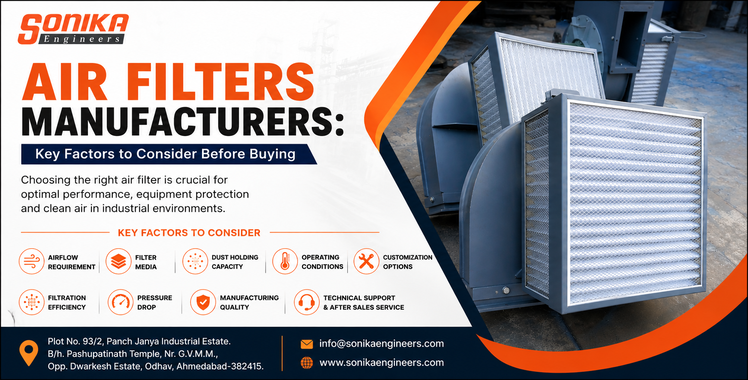
That's why it pays to be careful about which air filters manufacturers you work with. Before you place an order, it's worth thinking through airflow, filtration efficiency, filter media, pressure drop, dust loading, operating conditions, dimensions, customization options, and the kind of support the manufacturer actually offers.
Whether you're filtering air for a factory floor, a ventilation system, or an industrial blower, understanding these factors upfront will save you a lot of headaches down the line.
Why Choosing the Right Manufacturer Matters
No two industrial setups have quite the same filtration needs. A filter that works fine for general ventilation might struggle in a dusty manufacturing environment — and struggle badly.
A manufacturer worth your business should be able to offer:
-
Filter media suited to your application
-
The correct airflow capacity
-
Custom sizes when standard ones won't cut it
-
Consistent quality, order after order
-
Technical guidance when you need it
-
Replacement parts and after-sales support
An air filter supplier is a fine choice if you just need a standard, off-the-shelf product. But when your application calls for customization or a bit of technical back-and-forth, working directly with a manufacturer tends to make more sense.
10 Key Factors to Consider Before Buying an Industrial Air Filter
1. Check the Required Airflow
Airflow is usually the first thing to nail down. The filter you choose needs to handle your required air volume without choking it off with resistance.
Before you place an order, give the manufacturer your airflow requirement, your blower or fan capacity, the dimensions of your existing filter, and the space you have available for installation.
2. Consider Filtration Efficiency
How much filtration you actually need comes down to the type and concentration of particles you're dealing with.
Think about:
-
Particle size
-
Dust concentration
-
The air cleanliness you actually need
-
What equipment you're protecting
Here's the thing — the highest filtration rating isn't automatically the right answer. What you want is a filter that does the job without needlessly choking your airflow.
3. Select the Correct Filter Media
Filter media has a direct effect on how well the filter performs, how much pressure drop you get, and how long the filter lasts.
Depending on what you're filtering, your options might include synthetic, polyester, fiberglass, pleated, or other specialized media.
A manufacturer with real experience in air filtration can help you pick media based on dust type, temperature, humidity, and the broader operating conditions you're working in.
4. Check Pressure Drop
Pressure drop tells you how much resistance the air runs into as it passes through the filter.
Too much resistance and your airflow suffers, which in turn affects fan or blower performance. Don't be shy about asking the manufacturer for the initial pressure drop figure — and how that number is likely to climb as the filter loads up with dust over time.
5. Consider Dust-Holding Capacity
How long a filter lasts largely depends on how much dust it's exposed to, and what kind.
A filter with solid dust-holding capacity means fewer replacements and less maintenance hassle. Factor in dust concentration, operating hours, filter surface area, and the service conditions you expect to run under.
6. Confirm Dimensions and Installation
Getting the dimensions right matters, obviously — but don't overlook the mounting arrangement and sealing, because those matter just as much.
Have this ready:
-
Length, width, and depth
-
Frame details
-
Mounting arrangement
-
Available installation space
-
A photo of the existing filter
That last one — a photo of the old filter — is particularly handy when you're replacing something old or non-standard.
7. Evaluate the Operating Environment
If you're sourcing an air filter for factory use, think about what's actually in the air: dust, fibres, oil mist, moisture, chemicals, heat, and whatever else your process throws off.
A filter built for ordinary ventilation duty usually isn't up to the task in a demanding industrial process.
8. Ask About Customization
Not every piece of industrial equipment plays nicely with standard filter sizes.
Customization tends to come up when you're dealing with:
-
Non-standard dimensions
-
Special filter media
-
Tight installation space
-
Specific airflow requirements
-
Existing blower setups
When you're comparing industrial air filter manufacturers, ask directly whether they can build to your drawings, measurements, samples, or even just photographs.
9. Check Manufacturing Quality
Don't stop at the media itself — look at frame strength, sealing, how the media is fixed in place, dimensional accuracy, and overall build quality. All of it affects how the filter performs.
This matters even more if you're ordering filters repeatedly for production equipment, where consistency from batch to batch is non-negotiable.
10. Consider Technical Support
A good manufacturer doesn't just sell you a filter and disappear. They should be able to help with selection, replacement specs, customization questions, installation issues, and repeat orders down the road.
That kind of technical support becomes especially valuable when the filter is one piece of a larger industrial air-handling or blower system.
Choosing an Air Filter for Factory Applications
Every factory has its own filtration story to tell, depending on what's actually happening on the process side.
Before picking a filter, work out:
-
What contaminants you're dealing with
-
Required airflow
-
Operating temperature and humidity
-
The filtration level you actually need
-
Filter dimensions
-
Operating hours
-
Maintenance requirements
For anyone looking at industrial air filters manufacturers in India, having these details ready gives a much better starting point for a recommendation than just handing over a size and hoping for the best.
Air Filters for Industrial Blowers: What Should You Check?
Industrial blowers need the right inlet filtration to keep unwanted particles from getting into the equipment in the first place.
When you're talking to air blower filter manufacturers, discuss:
-
Blower airflow
-
Filter dimensions
-
Air inlet arrangement
-
Dust concentration
-
Filter media
-
Pressure drop
-
Cleaning or replacement needs
For air filters for industrial blowers, the goal is filtration that does its job without unnecessarily choking the blower's required airflow.
Air Filter Supplier vs. Manufacturer: Which Should You Choose?
An industrial air filters supplier works well when you just need a standard product that's readily available.
A manufacturer becomes the better call when you need:
-
Custom dimensions
-
Application-specific media
-
Technical guidance
-
Non-standard configurations
-
Filters built for blowers or industrial equipment
If your requirements are at all specialized, going straight to the manufacturer usually makes the whole selection process a lot smoother.
Air Filters vs. Air Purifiers: Are They the Same?
Not quite — air filters and air purifiers actually do different jobs.
Industrial filters are typically built into ventilation systems, equipment, or process-air lines. Air purifiers, on the other hand, are usually standalone devices meant to treat the air in an enclosed space.
So if you're searching for air purifier manufacturers, the first question to answer is whether you actually need a standalone purification unit or an industrial filtration component.
Common Mistakes to Avoid
A few buying mistakes come up again and again:
-
Choosing based on price alone
-
Ignoring pressure drop
-
Picking the wrong filter media
-
Buying purely by dimensions
-
Overlooking temperature and humidity
-
Not asking about customization
-
Giving incomplete application details
Spending a little time on the technical details before you order can save you from costly replacement problems later on.
Industrial Air Filter Buying Checklist
Before you request a quotation, have this information on hand:
|
Requirement |
Information |
|
Airflow |
CFM or m³/h |
|
Filter size |
Length × width × depth |
|
Application |
Equipment/process |
|
Contaminants |
Dust/particles |
|
Temperature |
Operating condition |
|
Installation |
Available space |
|
Quantity |
Required filters |
|
Existing filter |
Photo/specification |
The more complete this information is, the easier it becomes to recommend a filter that actually fits.
Why Choose Sonika Engineers?
Sonika Engineers supplies industrial fans, blowers, filters, and customized air-movement solutions out of Ahmedabad, Gujarat.
For filtration requirements, customers can share their existing filter dimensions, a photograph, application details, and their airflow requirement — and the technical team takes it from there, working out a suitable configuration based on what you actually need.
When blowers and filters are involved together, it often helps to think about the air-moving equipment and the filtration side as one package rather than two separate decisions — it tends to lead to a better overall fit.
FAQs
1. What should I consider when choosing an air filter manufacturer?
Look at manufacturing capability, filter media, airflow capacity, pressure drop, customization options, quality, technical support, and how much application experience they actually have.
2. How do I choose an industrial air filter for a factory?
Think through the contaminants involved, your airflow, the filtration level required, operating conditions, dimensions, and maintenance needs.
3. What information should I provide for a quotation?
Filter dimensions, airflow, application, contaminants, operating conditions, quantity, and a photo of your existing filter if you have one.
4. How do I select a filter for an industrial blower?
Check the blower's airflow, the filter size, dust concentration, filter media, and pressure drop — you want filtration that doesn't unnecessarily restrict airflow.
5. Can industrial air filters be customized?
Yes — depending on the manufacturer, you can typically customize dimensions, media, frame construction, airflow characteristics, and installation requirements.
Final Thoughts
The right industrial filter is the one that actually matches your application — not necessarily the cheapest one, and not necessarily the one with the flashiest rating.
Before you buy, weigh up airflow, filtration efficiency, pressure drop, filter media, dust loading, operating conditions, dimensions, and the kind of support the manufacturer offers.
If you need a customized industrial filter for a factory, ventilation system, or blower, share your filter dimensions, airflow requirement, application details, and a photo of your existing filter with Sonika Engineers — it's the fastest way to get to a solution that actually fits.